
Avatar de Inconnu

A propos Olivier Mamavi

Directeur des données chez Management & Data Science et enseignant-chercheur en intelligence économique

L’attachement préférentiel dans les alliances stratégiques pour obtenir des marchés publics

Mis en avant

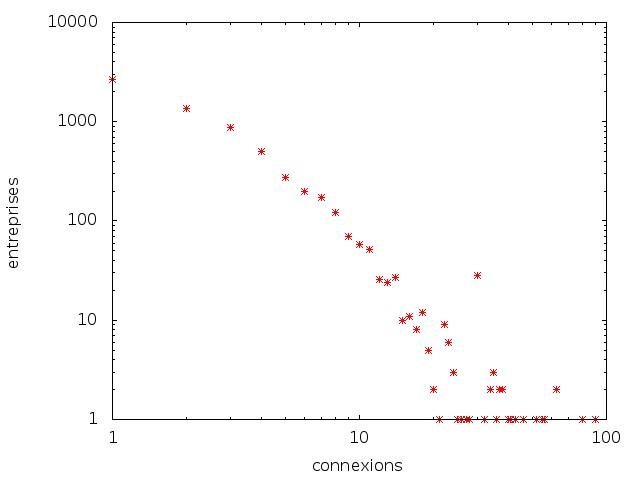
Preferential attachmentL’objectif de cet article est de mieux comprendre l’organisation des alliances stratégiques, ainsi que leur mode de fonctionnement dans le cas particulier des marchés publics. À partir de l’observation de 4 203 alliances sur ces marchés, ce travail montre que la formation des coalitions d’entreprises se fait, en grande partie, selon un principe d’attachement préférentiel. Ce mécanisme de cohésion n’est pas sans conséquence sur la façon de gérer les alliances. Il implique que les structures relationnelles d’une entreprise déterminent le choix des partenaires. L’article présente finalement des éléments d’amélioration en matière d’organisation des alliances et propose différentes pistes de réflexions.

Mamavi, O. et Meier, O. (2014). Le principe d’attachement préférentiel dans la formation des alliances stratégiques, Revue Française de Gestion, N°241, p.79-91. Téléchargez ici

L’open data comme levier de développement commercial

Mis en avant

Selon McKinsey, la valeur annuelle de l’open data se situe entre 3 220 et 5 290 milliards de dollars. A titre de comparaison, le PIB de l’Allemagne, 4e puissance mondiale est de 3 747 milliards. Tous les secteurs économiques sont concernés et les opportunités en termes d’amélioration de performance concernent à la fois la productivité et les revenus : trouver de nouveaux clients, améliorer le marketing mix, réduire les coûts marketing, concevoir de nouvelles offres .

En France, l’utilisation de l’open data se développe très rapidement depuis quelques années. L’Etat met à disposition ses données (www.data.gouv.fr), des start-up construisent des services sur la base de données ouvertes et des acteurs historiques ouvrent leurs données à leur écosystème (SNCF, Orange.).

. Quelles sont ces données ouvertes ?
. Quel est l’intérêt de les utiliser ?
. Comment en faire un levier de développement commercial ?
. Quelles sont les compétences à développer ?

Pour répondre à ces questions, l’ICD International Business School à invité le 12 mars 2015 des acteurs de l’open data en France à débattre autour des initiatives les plus marquantes:

  • François Bancilhon Directeur Général de Data Publica
  • Chloé Bonnet Co-fondatrice de l’Open Data Institute et de FiveByFive
  • Louis-David Benyayer Enseignant chercheur à l’ICD
  • Catherine Demongeot Directeur Marketing Chambre de commerce et d’Industrie de Paris
  • Céline Faivre SGMAP et Breizh Small Business Act
  • Olivier Mamavi Enseignant Chercheur à l’ICD

VIth International Conference « Contracts, Procurement, and Public-Private Arrangements »

VIth International Conference « Contracts, Procurement, and Public-Private Arrangements » focuses on the recent developments in contract theories. Papers are invited on all topics of contract theories including: Relational contracting, transaction costs, renegotiations, incentives, award mechanisms, incomplete contracting, contract design, benchmarking, privatization, corruption, institutions.

The conference will bring together academics, policymakers and practitioners to discuss those issues. The conference format will be designed to facilitate informal interactions among participants and promote future collaborations.  

The conference will take place on 4th and 5th June, 2015 at the Sorbonne Business School.

The conference is organized in cooperation with the Florence School of Regulation , the IESE Business School, the Centre for Market and Public Organisation at the University of Bristol, the Regulation and Governance research group at Paris Dauphine and the Paris School of Economics — OSE Labex.

PROGRAM IS ON LINE

Quelle intelligence peut-on trouver dans les données massives ? La cas des marchés publics français

Mis en avant

L’objet de cet article est d’expliquer comment les données des marchés publics peuvent être considérées comme des « big data », dans lesquelles il est possible de trouver de « l’intelligence ». Pour cela, nous faisons une analyse longitudinale des avis d’attribution issus du Bulletin Officiel des Annonces de Marchés Publics (BOAMP) sur la période 2006-2010. Les résultats montrent que les données massives permettent d’extraire des indicateurs structurels qui facilitent la prise de décision stratégique de l’acheteur public pour structurer ses appels d’offres et renforcer son pouvoir de décision dans la sélection des fournisseurs. Cela pose, ainsi, les fondements de futures applications d’intelligence économique dédiées aux achats publics.

Mamavi, O., et Morin, S. (2014). Quelle intelligence peut-on trouver dans les données massives ? La cas des marchés publics français. Revue Internationale d’Intelligence Économique, vol.6, pp. 131-42. Télécharger l’article

Les coulisses des marchés publics

Comment remporter des appels d’offres ? Quelles sont les stratégies qui facilitent l’accès des entreprises à la commande publique ? Quel est l’impact des réseaux sur la décision publique ? Qu’est-ce qu’un marché public ?

 C’est à de telles questions que cet ouvrage tente de répondre. Il analyse le lien entre l’environnement relationnel des entreprises et leur performance. Il fait le point sur la littérature et décrit la façon d’organiser, efficacement, des manœuvres de coopération pour obtenir des appels d’offres. Il propose une solution originale qui permet d’exploiter des données ouvertes (opendata) et massives (bigdata). Il présente une démarche qui explique comment les réseaux d’alliances influencent l’attribution des marchés publics.
    • Titre: Les Coulisses des marchés publics
    • Auteur: Olivier Mamavi
    • Éditeur : Éditions l’Harmattan
    • Collection / Série : Entreprises et management
    • Prix de vente au public (TTC) : 27 €
    • ISBN 978-2-343-05593-0
    • EAN 9782343055930

How does performance history impact supplier selection in the public sector?

Mis en avant

The paper studies if the performance history impacts supplier selection in the French public sector context. While French public procurement legislation forbids consideration of the past contract wins in supplier selection, public contractors may still rely on contract win history for highly complex transactions.  Using French Official Journals (BOAMP), we collected all public procurement transactions of 976 suppliers that had at least one transaction per year, over a period of six years (between 2006 and 2011). We conducted a two-level hierarchical linear auto-regression analysis and a feature evaluation analysis for all transactions.  The paper finds significant variation between the transactions of different markets, as well as in the overall positive impact of past wins and in the detailed impact patterns and thresholds of each market. The findings may allow refinement of existing contract awarding strategies and of current legislation.  The paper aims at empirically testing whether a supplier’s degree of success in any given year, measured by the number of public contracts won, may have an impact on the likelihood that the same supplier is awarded a public contract the following year. We conclude that suppliers retained for public contracts could benefit from building public buyers’ loyalty using a key account selling approach rather than systematically seeking to acquire new contracts.

Mamavi, O., Nagati, H., Werhle, F. et Paché, G., (2015). How performance history impact future supplier selections ? The case of French public procurement, Industrial Management & Data System. Vol. 115, n°1 – download here

The 6th International Public Procurement Conference (IPPC)

Ippc_banner

The International Public Procurement Conference (IPPC) is a global network of public procurement practitioners and researchers from over 100 countries. Objective is to advance and share knowledge and best practices in public procurement.  Biennial conferences provide privileged networking opportunities with high-level public procurement practitioners and experts.

Participants’ interest in sharing public procurement knowledge benefits government, business, and greater society across the world.

the 6th IPPC is in Dublin in August 2014. The conference is being hosted by The Irish Institute of Purchasing Management and Dublin City University. The Organising Committee is led by co-chairs Dr Paul Davis and Khi Thai.

Please see the conference website www.ippc6.com for regular updates.

Strategic Network

To analyze strategic networks, we have chosen to study the responses, through co-transacting, to invitation to tender in French public markets. Our study is based on the analysis of coalition relationships within company groups.

Data used for this study issues from the attribution notices from of the French Official Journals (BOAMP). From transactions made in 2008, we have selected, with key words, the transactions held only by groups of companies.

Table 1 details the census of the observed businesses. It shows the number of parties that we identified within the groups. Obtaining this data goes through a multi-stage process: extraction, cleaning, filtering, formatting, dedoubling and indexing. The nature of the data used to analyze the groups of companies is held by three variables. The first is allotted to the identification of the parties (business reasons). The second is ascribed to the type of beneficiaries of the transactions (company groups). The third variable concerns the cooperative relation which links the parties within a group. We have considered that there is a cooperative relationship with two companies when they obtain a market within the bounds of co-transaction (a belonging to a group of companies).

table 1 : characteristics of the identified companies

Total number of transactions

54 181

Number of transactions undertaken by groups

4 203

Number of companies within the groups

6 563

Number of cooperation links

10 377

PublicProcurement.fr provides free access to its datasets. To download datasets click here: adjacency list strategic network 2008
For more information and if you have any questions contact us at: omamavi@groupe-igs.fr

French contract award records

The data were taken from the contract award records of the Bulletin Officiel des Annonces des Marchés Publics (BOAMP). From 2006 to 2011, 565,557 transactions completed between 6,182 contractors (procurers) and 26,570 suppliers were analyzed.

The BOAMP compiles calls for tenders and contract award results at the state, local community and public establishment levels. The contract award notice states the public procurer’s decision, along with the following information: identification of the principal and the tenderers, the type of market, type of procedure, awarding criteria, and publication date. The distribution of transactions by sector is based on the CPV (for Common Procurement Vocabulary) classification.

The CPV is the reference nomenclature for public markets adopted by the European Parliament. The CPV assigns a nine-digit code to about 6,000 terms generally used in awarding contracts on public markets. To simplify the analysis, we have retained three main sectors.

  • The works market, which covers building construction or civil engineering projects (e.g. construction of a hospital or road repairs).
  • The service market, which covers building cleaning and maintenance, and household waste collection services.
  • The goods market, which covers provision of capital equipment and consumer goods (e.g. furniture or office supplies).

PublicProcurement.fr provides free access to its datasets.To download datasets click here: french prublic procurement in 2008
For more information and if you have any questions contact us at: omamavi@groupe-igs.fr